In this guide (10)
- How does a sangeet run, and when does the host speak?
- Opening and welcome: how do you start?
- How do you introduce the two families?
- Lines between performances (10 lines)
- How do you introduce a game on the mic?
- Shayari for the sangeet host (original, free to use)
- What do you say when something goes wrong?
- Closing and dinner announcement
- Tips for first-time sangeet hosts
- FAQs
- A sangeet has 8 moments where the host speaks: welcome, the couple's entry, family intros, links between performances, game intros, elders on stage, the couple's dance and the closing.
- Keep the welcome to 2–3 minutes and every link between performances under one minute. The stage belongs to the performers.
- Give ladkewale and ladkiwale equal time and equal praise. People notice when one side gets more.
- Fill in every name, relation and city before the function. Never guess a name on stage.
- Keep one shayari ready for each big moment, and a light line for when the mic dies or the wrong song plays.
The easiest way to host a sangeet without freezing is to have a line ready for every moment the music stops. Below is a working script for each part of the evening, in Hindi (Devanagari) with the same line in Roman Hinglish under it, so you can read whichever is easier on stage.
Blanks (______) are for names, relations and places. Fill them in the night before, in pen.
How does a sangeet run, and when does the host speak?
A typical sangeet runs about 3 hours. This is a running order that works for most families. Move the times to fit your evening.
| Time | What happens | Host's job |
|---|---|---|
| 0:00 | Guests arrive, background music | Stay off the mic, greet people |
| 0:20 | Welcome and opening | 2–3 min welcome |
| 0:30 | The couple's story and entry | Introduce the couple |
| 0:35 | Family introductions | Name both families, equal time |
| 0:40 | Performance block 1 (4–5 dances) | Short link before each one |
| 1:20 | Game 1 and result | Run the game, 10 min |
| 1:30 | Performance block 2 (4–5 dances) | Short links |
| 2:05 | Elders invited on stage | Call them up gently |
| 2:15 | Game 2: ladkewale vs ladkiwale | Run the game, 10 min |
| 2:25 | The couple's dance | Introduce it, then stay silent |
| 2:35 | Thanks and closing | Announce dinner and dance floor |
Tip: Print this running order three times: one for you, one for the DJ, one for whoever sends performers up from backstage. Phones die; paper does not.
Opening and welcome: how do you start?
Start when most guests are seated and the music is turned down. Speak slowly and pause after each line so there is room for claps.
- नमस्ते, नमस्ते, नमस्ते! आप सबका इस खूबसूरत शाम में दिल से स्वागत है।
Namaste, namaste, namaste! Aap sabka is khoobsurat shaam mein dil se swagat hai. - मैं हूँ ______, ______ का/की ______, और आज रात आपका होस्ट बनने का मौका मुझे मिला है।
Main hoon ______, ______ ka/ki ______, aur aaj raat aapka host banne ka mauka mujhe mila hai. - आज हम सब यहाँ एक ही वजह से इकट्ठा हुए हैं: ______ और ______ की संगीत संध्या!
Aaj hum sab yahan ek hi wajah se ikattha hue hain: ______ aur ______ ki sangeet sandhya! - एक तरफ़ है ______ परिवार, जिन्होंने इतने प्यार से ये पूरी शाम सजाई है।
Ek taraf hai ______ parivaar, jinhone itne pyaar se yeh poori shaam sajaayi hai. - और दूसरी तरफ़ है ______ परिवार, जो आज से हमारे अपने हैं।
Aur doosri taraf hai ______ parivaar, jo aaj se humare apne hain. - तो फ़ोन साइलेंट पर नहीं, कैमरा मोड पर रखिए, क्योंकि आज बहुत कुछ रिकॉर्ड करने लायक होने वाला है।
Toh phone silent par nahi, camera mode par rakhiye, kyunki aaj bahut kuch record karne laayak hone waala hai. - एक बार ज़ोरदार तालियाँ हो जाएँ, हमारे दोनों परिवारों के लिए!
Ek baar zordaar taaliyan ho jaayein, humare dono parivaaron ke liye!
In line 2, "ka" or "ki" depends on your relation word: "ka" for bhai, mama or chacha (dulhan ka bhai), "ki" for behen, saheli or bua (dulhe ki behen). In Devanagari, the same rule gives का or की. If you are hired or a family friend, simply say "aur aaj raat aapka host main hoon."
Tip: Add one shayari from the list further down right after line 3. It gives the opening a lift and buys you a breath.
How do you introduce the two families?
Name the bride's parents and the groom's parents with "ji", then the grandparents, then everyone else as a group. Give both sides the same number of lines.
- आज इस हॉल में दो परिवार बैठे हैं, लेकिन दिल सबका एक ही है।
Aaj is hall mein do parivaar baithe hain, lekin dil sabka ek hi hai. - लड़कीवालों की तरफ़ से स्वागत करते हैं ______ जी और ______ जी का, यानी हमारी दुल्हन के मम्मी-पापा।
Ladkiwaalon ki taraf se swagat karte hain ______ ji aur ______ ji ka, yaani humari dulhan ke mummy-papa. - और लड़केवालों की तरफ़ से, ______ जी और ______ जी, यानी हमारे दूल्हे के मम्मी-पापा। आपका दिल से स्वागत है।
Aur ladkewaalon ki taraf se, ______ ji aur ______ ji, yaani humare dulhe ke mummy-papa. Aapka dil se swagat hai. - साथ में हैं दादा-दादी, नाना-नानी, चाचा-चाची, मामा-मामी, और कज़िन्स की पूरी फ़ौज।
Saath mein hain dada-dadi, nana-nani, chacha-chachi, mama-mami, aur cousins ki poori fauj. - लड़कीवाले कहाँ हैं? आवाज़ आनी चाहिए!
Ladkiwaale kahan hain? Awaaz aani chahiye! - लड़कीवालों ने अपनी लाडली को इतने प्यार से बड़ा किया है, आज उनके लिए तालियाँ तो बनती हैं।
Ladkiwaalon ne apni laadli ko itne pyaar se bada kiya hai, aaj unke liye taaliyan toh banti hain. - अब लड़केवाले! ज़रा दिखाइए कि आवाज़ किसकी ज़्यादा है!
Ab ladkewaale! Zara dikhaaiye ki awaaz kiski zyada hai! - इन्होंने भी अपने लाडले को उतने ही प्यार से पाला है, और आज से ये हमारे अपने हैं, तो इनके लिए भी उतनी ही ज़ोरदार तालियाँ।
Inhone bhi apne laadle ko utne hi pyaar se paala hai, aur aaj se yeh humare apne hain, toh inke liye bhi utni hi zordaar taaliyan.
If you are from the groom's side, move "aur aaj se yeh humare apne hain" from line 8 to the end of line 6, so it is said about the bride's family. If one parent has passed away or cannot attend, name only who is present, or say "______ parivaar" instead of naming the parents, and check with the family first.
Tip: Get the names and relations written on one sheet by someone from each family. Practise the hard names aloud. Getting an elder's name wrong on the mic is the mistake people remember.
Lines between performances (10 lines)
Each link should be under one minute. Before a performance, say who is coming and who it is for. After it, one line of praise, then move on.
Before a performance
- अब बारी है एक ऐसी परफ़ॉर्मेंस की, जिसकी तैयारी कई हफ़्तों से चुपके-चुपके चल रही थी।
Ab baari hai ek aisi performance ki, jiski taiyaari kai hafton se chupke-chupke chal rahi thi. - स्टेज पर आ रहे हैं ______ के ______, यानी ______ और ______।
Stage par aa rahe hain ______ ke ______, yaani ______ aur ______. - सुना है रिहर्सल में चाय कम और स्टेप्स ज़्यादा हुए हैं।
Suna hai rehearsal mein chai kam aur steps zyada hue hain. - अब स्टेज पर आ रही है वो टीम, जिसने रिहर्सल के लिए सबकी नींद उड़ा दी थी।
Ab stage par aa rahi hai woh team, jisne rehearsal ke liye sabki neend uda di thi. - बच्चों की ये परफ़ॉर्मेंस छोटी है, पर दिल जीतने के लिए काफ़ी है।
Bachchon ki yeh performance chhoti hai, par dil jeetne ke liye kaafi hai. - अब जो परफ़ॉर्म करने आ रहे हैं, उनके अनुभव के आगे सारी रिहर्सल फ़ेल है।
Ab jo perform karne aa rahe hain, unke anubhav ke aage saari rehearsal fail hai. (for an elders' performance)
After a performance
- वाह! क्या परफ़ॉर्मेंस थी। एक बार फिर तालियाँ!
Waah! Kya performance thi. Ek baar phir taaliyan! - पानी पी लीजिए, सीट पकड़ लीजिए, अगली परफ़ॉर्मेंस धमाकेदार है।
Paani pee lijiye, seat pakad lijiye, agli performance dhamaakedaar hai. - जो लोग खाने की तरफ़ देख रहे हैं, बस दो परफ़ॉर्मेंस और, वादा।
Jo log khaane ki taraf dekh rahe hain, bas do performance aur, waada. - कैमरा वाले दोस्तों, तैयार रहिए, अगला सीन फ़्रेम करने लायक है।
Camera waale doston, taiyaar rahiye, agla scene frame karne laayak hai.
Tip: Never use the same link twice in one evening. Tick each line off on your printout as you use it.
How do you introduce a game on the mic?
Say the name, how many people you need, the rule in one sentence, the time limit and the prize. Then say the rule a second time and show it once with a volunteer.
- अब थोड़ा ब्रेक लेते हैं नाच से, और खेलते हैं एक मज़ेदार गेम!
Ab thoda break lete hain naach se, aur khelte hain ek mazedaar game! - गेम का नाम है ______।
Game ka naam hai ______. - इसके लिए मुझे चाहिए ______ लोग, लड़केवालों की तरफ़ से भी और लड़कीवालों की तरफ़ से भी।
Iske liye mujhe chahiye ______ log, ladkewaalon ki taraf se bhi aur ladkiwaalon ki taraf se bhi. - नियम बहुत आसान हैं: ______।
Niyam bahut aasaan hain: ______. - और जीतने वाले को मिलेगा एक शानदार इनाम: ______!
Aur jeetne waale ko milega ek shaandaar inaam: ______!
Filled in, for a dance-off game:
"Ab thoda break lete hain naach se. Game ka naam hai Dance-Off Chits. Mujhe chahiye chaar log, do ladkewaalon ki taraf se aur do ladkiwaalon ki taraf se. Niyam bahut aasaan hain: bowl se ek parchi uthaiye, us par jo style likha hai, usi style mein tees second naachiye. Humare judges hain Nani ji aur Chacha ji. Aur jeetne waali team ko milega mithai ka poora dabba!"
For 20 ready games with rules and a host line for each, see our list of sangeet games for the audience.
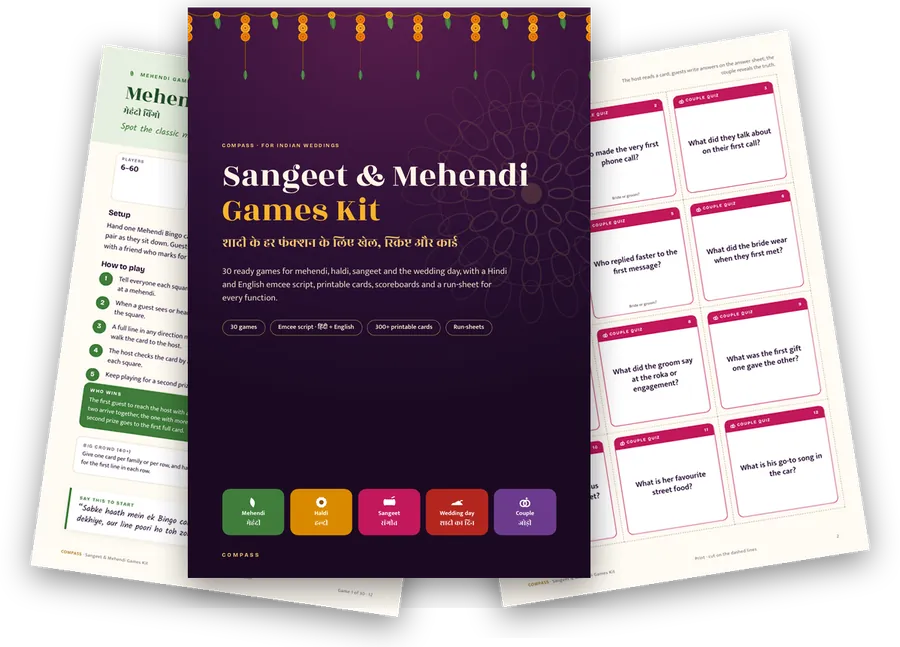
- ✓30 family-safe games with rules and timings
- ✓Emcee script in 3 languages
- ✓360+ printable cards incl. 60 shoe-game questions
- ✓Play from your phone if you have no printer
Shayari for the sangeet host (original, free to use)
These are written for this page, so you can use them without worrying about copying anyone. Say the first line, pause, then the second line a little slower.
1. For the opening
रंगों से सजी है आज की ये शाम,
दो परिवारों के मिलने का है ये पैग़ाम।
Rangon se saji hai aaj ki yeh shaam,
do parivaaron ke milne ka hai yeh paigaam.
2. For the couple's entry
दो दिल, एक धुन, एक ही सपना,
आज से हर पल है इन दोनों का अपना।
Do dil, ek dhun, ek hi sapna,
aaj se har pal hai in dono ka apna.
3. For the bride's family
जिस घर ने बेटी को इतने प्यार से पाला,
आज उसी घर ने दिल का दरवाज़ा और बड़ा कर डाला।
Jis ghar ne beti ko itne pyaar se paala,
aaj usi ghar ne dil ka darwaaza aur bada kar daala.
4. For the groom's family
दूल्हे के घरवालों का क्या कहना,
इनकी मुस्कान है आज की शाम का गहना।
Dulhe ke gharwaalon ka kya kehna,
inki muskaan hai aaj ki shaam ka gehna.
5. Before a performance
क़दमों में है ताल, चेहरों पे मुस्कान,
अगली परफ़ॉर्मेंस खींचेगी सबका ध्यान।
Qadmon mein hai taal, chehron pe muskaan,
agli performance kheenchegi sabka dhyaan.
6. Before a game
नाच हो गया, अब थोड़ा खेल हो जाए,
दोनों परिवारों का थोड़ा और मेल हो जाए।
Naach ho gaya, ab thoda khel ho jaaye,
dono parivaaron ka thoda aur mel ho jaaye.
7. For the elders
जिनकी दुआओं से रोशन है ये घर-आँगन,
उन्हीं के आशीर्वाद से मज़बूत है हर बंधन।
Jinki duaaon se roshan hai yeh ghar-aangan,
unhi ke aashirwaad se mazboot hai har bandhan.
8. Before the couple's dance
एक-दूजे का हाथ थामे, यूँ ही चलते रहना,
हर मुश्किल में भी साथ, हँसते रहना।
Ek-dooje ka haath thaame, yun hi chalte rehna,
har mushkil mein bhi saath, hanste rehna.
9. Before dinner
गाने भी हो गए, ठुमके भी लग गए,
अब खाने की ख़ुशबू से सबके दिल जग गए।
Gaane bhi ho gaye, thumke bhi lag gaye,
ab khaane ki khushboo se sabke dil jag gaye.
10. For the closing
शाम ढलेगी, पर ये पल न ढलेंगे,
इन यादों के दीये बरसों जलेंगे।
Shaam dhalegi, par yeh pal na dhalenge,
in yaadon ke diye barson jalenge.
Tip: Two or three shayari in an evening is plenty. More than that and the crowd starts waiting for the punchline instead of the next dance.
What do you say when something goes wrong?
Something always goes wrong: the mic cuts out, the next team is not ready, the DJ plays the wrong track. Smile, say one light line, and move on. Never blame the DJ, a performer or a family member on the mic.
- The mic stops: लगता है माइक भी शरमा गया! एक मिनट, तब तक सब अपने पड़ोसी को हैलो बोलिए।
Lagta hai mic bhi sharma gaya! Ek minute, tab tak sab apne padosi ko hello boliye. - A performer forgets the steps: असली डांसर की पहचान है, स्टेप भूलकर भी चेहरे पर मुस्कान। तालियाँ इनके हौसले के लिए!
Asli dancer ki pehchaan hai, step bhoolkar bhi chehre par muskaan. Taaliyan inke hausle ke liye! - The wrong song plays: ये तो बस वॉर्म-अप था! DJ जी, अब असली वाला चलाइए, प्लीज़।
Yeh toh bas warm-up tha! DJ ji, ab asli waala chalaaiye, please. - The next team is not ready: अगली टीम बस तैयार हो रही है, तब तक एक छोटा सा सवाल: यहाँ सबसे दूर से कौन आया है?
Agli team bas taiyaar ho rahi hai, tab tak ek chhota sa sawaal: yahan sabse door se kaun aaya hai? - The DJ is looking for a track: जब तक DJ जी गाना ढूँढ रहे हैं, सब अपने बगल वाले को बताइए कि आज उनका आउटफ़िट कितना अच्छा लग रहा है।
Jab tak DJ ji gaana dhoondh rahe hain, sab apne bagal waale ko bataiye ki aaj unka outfit kitna achha lag raha hai. - The room has gone quiet: चलिए, एक छोटा सा टेस्ट। जिसने आज कम से कम एक बार डांस किया है, वो हाथ ऊपर करे। और जिसने नहीं किया, वो अगले गाने पर स्टेज पर मिले!
Chaliye, ek chhota sa test. Jisne aaj kam se kam ek baar dance kiya hai, woh haath upar kare. Aur jisne nahi kiya, woh agle gaane par stage par mile!
For a longer gap (5 minutes or more), run a clap chain: clap once and ask the room to copy, then twice, then three times, add a stamp of the feet and a loud "Hey!", speed it up until people laugh, and finish with one big clap together. It takes 2 minutes and needs nothing.
Tip: Keep a backup mic and fresh batteries next to your water bottle. Most "dead air" at a sangeet is a dead mic battery.
Closing and dinner announcement
Close right after the couple's dance, while the energy is high. Thank people in this order: everyone who performed, the two families, the people who worked behind the scenes, and the couple.
- दोस्तों, आज की शाम सच में यादगार रही।
Doston, aaj ki shaam sach mein yaadgaar rahi. - हर परफ़ॉर्मर, हर गेम खेलने वाले, और हर ताली बजाने वाले, आप सबका दिल से शुक्रिया।
Har performer, har game khelne waale, aur har taali bajaane waale, aap sabka dil se shukriya. - ______ और , आज की ये शाम आपके नाम थी, और आने वाली हर शाम भी इतनी ही ख़ुशनुमा हो।
* aur ______, aaj ki yeh shaam aapke naam thi, aur aane waali har shaam bhi itni hi khushnuma ho.* - अब खाना तैयार है, और डांस फ़्लोर खुला है।
Ab khaana taiyaar hai, aur dance floor khula hai. - कल की रस्म का टाइम याद रखिए: ______ बजे, ______ में। देर से आने वालों को अगली बार डांस करना पड़ेगा!
Kal ki rasm ka time yaad rakhiye: ______ baje, ______ mein. Der se aane waalon ko agli baar dance karna padega!
Signal the DJ on your last line so a dance track starts the moment you put the mic down.
Tips for first-time sangeet hosts
- Read the script aloud twice the day before. Your voice gets used to the words, and you stop sounding like you are reading.
- Fill every blank in advance: names, relations, cities, the couple's story. Ask one friend of the couple for 2 or 3 sweet facts, and nothing that could embarrass them.
- Meet the DJ before guests arrive. Agree on two signals: thumbs up to start, a flat hand across the neck to stop.
- Hold the mic about two fingers from your mouth and speak slower than feels normal. Fast speech sounds unclear on hall speakers.
- Pause after every line that should get claps. Two seconds of silence feels long to you and right to the audience.
- Keep your phone at full brightness with notifications off, or use a printout. Big text matters on a dim stage.
- Keep water and a stool near the stage. A dry throat is the most common reason hosts sound nervous.
- Ask before you call anyone up, especially elders and shy guests. When elders come up, keep a chair near the stage and a slow, old favourite song ready.
- During the couple's dance, say nothing. Introduce it, dim the lights, and let the moment happen.
- Keep it short. Guests came to watch the performers, so say your line and hand the stage back.
If you are also hosting the mehendi, our hands-free mehendi games are built for guests who cannot use their hands.
Frequently asked questions
How do you start sangeet anchoring?
Wait until most guests are seated and the music is turned down, then greet everyone, say who you are and how you are related to the couple, name both families, and ask for one big round of applause. Keep the opening under 3 minutes and pause after each line that should get claps.
How long should a sangeet host speak?
About 2 to 3 minutes for the welcome, under 1 minute for each link between performances, and 1 to 2 minutes for the closing. Running the games takes longer, so plan about 10 minutes of mic time for each game.
What shayari works for a sangeet?
Short, simple two-line shayari about the couple, the two families or the evening works best. Avoid anything about the bride leaving home or sad themes, and avoid jokes about in-laws. The original lines in this article are free to use.
How do you introduce the bride's family at a sangeet?
Name the bride's parents first with 'ji', then the grandparents, then the wider family as a group, and ask them to wave. Then do the same for the groom's family, with the same warmth and the same length, so neither side feels second.
Can a family member host the sangeet?
Yes, and most sangeets are hosted by a cousin, sibling or close friend. A family host knows the names and the stories, which a professional anchor has to learn. Read the script aloud twice the day before and keep a printed copy in your pocket.
Should the sangeet script be in Hindi or Hinglish?
Match the room. In a North Indian family with many elders, Hindi feels warm and respectful. With a younger or mixed-language crowd, Hinglish sounds more natural. Many hosts switch between the two, using Hindi for blessings and Hinglish for games.
Want the full script with every blank ready to fill?
The Sangeet & Mehendi Games Kit has the complete emcee script in Hindi, Hinglish and English, in a phone-size version and an editable copy to type the names in, plus mehendi and haldi scripts, ready lines for awkward moments, 30 games and a run-sheet for every function.
See the games kit · ₹399 →