In this guide (11)
- How do you pick the right games for your crowd?
- Games for the whole audience
- Games for family: ladkewale vs ladkiwale
- Games for the bride and groom
- Ladies sangeet and mahila sangeet games
- Games for kids at a sangeet
- Sangeet games with zero props
- A ready 45-minute sangeet game plan
- Host lines to start, link and end the games
- How to keep sangeet games family-safe
- FAQs
- For a mixed crowd, start with zero-prop, seated games (Pass the Mic, Know the Other Family), then move to stage games (Dance-Off Chits, Dumb Charades).
- Play 3 to 5 games in a 45-minute games block, or one 10-minute game between performance blocks if your sangeet has many dances.
- Ladkewale vs ladkiwale is the easiest way to make two families mingle: one chart-paper scoreboard turns every game into a friendly contest.
- End on the couple: the Shoe Game or Same Answer Challenge, with 2 or 3 sweet questions saved for last.
- Keep it family-safe: no questions about money or looks, and check before you pull an elder or a shy guest on stage.
If you have been handed the games duty for a sangeet, here is everything you need: 20 games that work for an Indian crowd of all ages, a table to pick the right ones in two minutes, and a ready 45-minute plan you can run as it is.
Every game has the same parts: how many players, what you need, how long it takes, how to play, how to win, and the line to say on the mic to start it. Most need nothing more than paper, a bowl and a phone.
How do you pick the right games for your crowd?
Look at three things: who is in the room, whether people will stand up, and what props you can arrange by tonight. A sangeet with 40 relatives in a living room needs different games from a banquet hall with 300 guests and a stage.
| Game | Best for | Players | Props | Time | Energy |
|---|---|---|---|---|---|
| Dance-Off Chits | Whole audience | 10–200 | Chits, bowl, speaker | 15–20 min | High |
| Dumb Charades: Stage Edition | Whole audience | 8–200 | Film list, timer | 20–30 min | Medium |
| Hum It | Whole audience, elders | 8–200 | Theme list, timer | 15–20 min | Medium |
| One Word, One Song | Whole audience | 10–200 | Word list, timer | 15–20 min | Medium |
| Pass the Mic | Whole audience, elders | 10–200 | Mic, speaker | 15–20 min | Medium |
| Family Survey Says | Whole audience | 10–200 | Chart paper | 20–25 min | Medium |
| Know the Other Family | The two families | 10–200 | Question list | 15–20 min | Medium |
| Dance Step Chain | The two families | 8–60 | Speaker | 15 min | High |
| Who Said This? | Family, elders | 6–50 | A list of sayings | 15–20 min | Calm |
| The Shoe Game | Couple | 2 + crowd | 2 chairs, shoes | 10–15 min | Medium |
| Same Answer Challenge | Couple | 2 + crowd | 2 notebooks, markers | 10–15 min | Calm |
| Who Knows the Couple Best | Couple + guests | 6–60 | Questions, paper | 15–25 min | Medium |
| Theme Antakshari | Ladies sangeet | 6–50 | Theme list, timer | 20–40 min | Medium |
| Pass the Potli | Ladies sangeet | 8–40 | Potli, task chits | 15–20 min | Medium |
| Sach ya Gappa | Ladies sangeet, elders | 6–50 | Nothing | 15–20 min | Calm |
| Musical Chairs: Sangeet Twist | Kids, teens | 8–20 a round | Chairs, speaker | 10–15 min | High |
| Sangeet Statue | Kids, everyone | 8–50 | Speaker | 10 min | High |
| Guess the Baby Photo | Everyone | 6–60 | Photos, paper | 15–20 min | Calm |
| Dialogue Remix | Zero props | 10–200 | Nothing | 15 min | Medium |
| Stand Up If | Zero props, warm-up | Any | Nothing | 2–5 min | Medium |
Three rules make almost any sangeet work:
- Seated games first, stage games later. People join a game from their chair long before they will walk up to a stage.
- One volunteer per side. Asking for "one person from ladkewale, one from ladkiwale" gets hands up faster than "who wants to play?".
- Keep a prize table near the stage. Small prizes (a box of mithai, a chocolate pack, "first plate at dinner") get far more volunteers for the next round.
Tip: Make one ladkewale vs ladkiwale scoreboard on chart paper and keep it on an easel or the wall all evening. Add points from every game, and announce the final score just before dinner.
Games for the whole audience
These six work in a hall of 200 as well as a living room of 20.
1. Dance-Off Chits (डांस की पर्ची)
Players: 10–200 · You need: 10–15 folded chits with a dance style on each, a bowl, phone and speaker, a scoreboard · Time: 15–20 min
Write the chits before the function. Some that get laughs: dance like you are stuck in Mumbai traffic; do the naagin dance, but very politely; dance like a robot that just learnt bhangra; dance in slow motion like a 90s film hero; dance like the Wi-Fi just came back; dance like your phone is at 1 percent battery; dance like you are trying not to wake the baby; dance like you just won the IPL.
- Pick 2 or 3 elders as judges and seat them in the front row.
- Call one dancer from each side onto the stage.
- Each dancer picks a chit and reads it out loud.
- Play any song for 30 seconds while both dance their style.
- Judges give each dancer up to 5 points. Write them on the scoreboard and call the next pair.
How to win: the side with the most points after all rounds wins.
Host line: "Ladkewale ready? Ladkiwale ready? Parchi uthaiye, style dekhiye, aur stage hila dijiye!"
Tip: Change the song every round and ask the judges to call out their scores loudly, so the crowd cheers along. For a quick version, play only 4 pairs.
2. Dumb Charades: Stage Edition (डम्ब शराड्स)
Players: 8–200 · You need: 30 film names written on chits, a phone timer, the scoreboard · Time: 20–30 min
Mix easy and tricky films. Wedding films land well at a sangeet: Hum Aapke Hain Koun..!, Dilwale Dulhania Le Jayenge, Band Baaja Baaraat, Vivah, Tanu Weds Manu, Jab We Met, Monsoon Wedding, Bareilly Ki Barfi. Add classics for the elders (Sholay, Padosan, Chupke Chupke, Golmaal, Angoor) and recent hits for the cousins (Dangal, Chhichhore, Stree, Zindagi Na Milegi Dobara).
- Make two teams and seat each on one side of the stage.
- Explain the signs: fingers for the number of words, tug your ear for "sounds like".
- One player picks a film chit without showing anyone except the host.
- They act out the title without speaking or mouthing words. Their team has 90 seconds.
- A correct guess wins a point. Then the other team plays.
How to win: the team with the most points after 8 to 10 turns each.
Host line: "Bolna mana hai, sirf acting chalegi! Aaiye dekhte hain kaunsi team film ka naam sabse pehle pakadti hai."
Tip: In a big hall, only the actor's team guesses aloud. If they miss, the other side gets one guess to steal the point. This stops 200 people shouting at once.
3. Hum It (धुन पहचानिए)
Players: 8–200 · You need: a list of round themes, a phone timer, a mic if there is one · Time: 15–20 min
Themes that work: rain songs, songs with "chaand" in them, 90s songs, songs that play at every wedding, songs about friendship, songs about mothers and family.
- Make two teams and announce the theme for the round.
- One player thinks of a song that fits and hums the tune into the mic, mouth closed, no words at all.
- Their team has 30 seconds to name the song or the film.
- If they miss, the other team gets one guess to steal the point.
- Take turns, with a new hummer each time.
How to win: one point per correct guess. Most points wins.
Host line: "Aaj gaane ke shabd nahi, sirf dhun! Dhun gungunaiye aur apni team ko gaana pehchanwaiye."
Tip: Ask a grandparent to hum an old song. The young cousins racing to name it is often the best moment of the game.
4. One Word, One Song (एक शब्द, एक गाना)
Players: 10–200 · You need: a list of 15–20 words, a phone timer, the scoreboard · Time: 15–20 min
Use everyday words that appear in many Hindi film songs: dil, pyaar, chaand, baarish, sapna, dost, yaar, raat, safar, zindagi, aasmaan, phool, rang, mausam, yaad, dulhan, shaadi, baaraat, naach, party.
- Make two teams.
- Call out one word.
- Team A has 10 seconds to sing one line of any song with that word in it.
- Team B must then sing a different song with the same word.
- Go back and forth until one team cannot find a song in time. The other team wins that word.
How to win: one point per word won. Most points wins.
Host line: "Ab ek shabd aayega, aur aapko us shabd wala gaana gaana hai, sirf das second mein. Taiyaar hain?"
Tip: Start with "dil" to warm the crowd up. Save harder words like "safar" or "aasmaan" for the end.
5. Pass the Mic (माइक पास)
Players: 10–200 · You need: a mic (or a hairbrush), phone and speaker · Time: 15–20 min
- Guests stay in their seats. Announce the three choices: sing 2 lines of any song, give the couple a one-line wish, or dance for 10 seconds.
- Play music and start passing the mic from the front row.
- Guests pass it to the person next to them or behind them.
- When the music stops, the person holding the mic stands and picks one of the three choices.
- Start the music again from them. Play 6 to 10 stops.
How to win: no winner needed. If you want one, the couple picks their favourite moment and hands over a prize.
Host line: "Ye mic ghoomega, music ruka toh mic aapka. Gaana, dua ya dance, choice aapki!"
Tip: Make sure the music stops on an elder at least once. A grandparent's wish for the couple often becomes the moment people remember.
6. Family Survey Says (जनता का जवाब)
Players: 10–200 · You need: 4–6 survey questions with answers, chart paper and a marker, the scoreboard · Time: 20–25 min
Three days before, send 6 to 8 questions on WhatsApp to at least 20 relatives and note the top 5 answers for each. Good questions: name something every Indian mom packs for a train journey; name a sweet served at almost every Indian wedding; name something you need for a mehendi function; name something kids do at a wedding.
- Read one question out loud.
- Team A guesses one answer at a time.
- If an answer is in the top 5, write it on the chart paper. Give 5 points for the top answer, down to 1 for the fifth.
- After 3 wrong guesses, Team B gets one chance to steal all the points so far.
- Reveal any answers not guessed, then switch which team starts.
How to win: most points after all questions.
Host line: "Humne bees rishtedaaron se sawaal poochhe. Ab bataiye, sabse popular jawaab kya tha?"
Tip: If too few relatives reply, use common-sense answers instead and say so on the mic. For the train-journey question, typical answers are homemade food or parathas, water bottles, snacks and namkeen, pickle, and a shawl or bedsheet (a guess, not survey data).
Games for family: ladkewale vs ladkiwale
These games give each side a reason to talk to the other, which is the real job of a sangeet.
7. Know the Other Family (जान-पहचान)
Players: 10–200 · You need: 8–10 questions about each family with answers, the scoreboard · Time: 15–20 min
Fill in the answers beforehand with one elder from each side. Use warm questions: Which city is the ___ family originally from? What dish is always made at the ___ family's home on Sundays? Which festival does the ___ family celebrate the biggest? Who is the best cook in the ___ family? Which film does the ___ family watch again and again? Which song gets the whole ___ family dancing?
- Ask the bride's side a question about the groom's family.
- The team has 20 seconds to agree and give one answer.
- An elder from the groom's side says if it is right and tells the short story behind it.
- Ask the groom's side a question about the bride's family.
- Take turns until all questions are done.
How to win: one point per correct answer. The side with the most points wins.
Host line: "Aaj se do families ek ho rahi hain. Toh aaiye dekhte hain, aap ek doosre ke baare mein kitna jaante hain!"
Tip: Keep questions to food, places, hobbies and funny habits. Skip money, looks, jobs and anything personal.
8. Dance Step Chain (डांस चेन)
Players: 8–60 · You need: phone and speaker, the scoreboard · Time: 15 min
- Each side sends 5 to 8 players to stand in a line on stage. Play one steady song through the game.
- The first player of Team A does one simple step and names it out loud ("thumka").
- The next player repeats that step and adds one new step.
- Each player repeats all the steps so far, in order, then adds one.
- A forgotten step or a wrong order ends the chain. Count the steps, then Team B plays.
How to win: the longer chain wins the round. Play 2 rounds.
Host line: "Ek step, phir do, phir teen. Sabke steps yaad rakhne hain! Dekhte hain kis team ki memory sabse tez hai."
Tip: Ask the crowd to copy each step from their seats. By the end, the whole hall is doing a group dance.
9. Who Said This? (ये किसने कहा?)
Players: 6–50 · You need: 15–20 family sayings and who says each, written on one sheet · Time: 15–20 min
A few days before, ask cousins on WhatsApp for loving lines that family members always say. Ideas to get them going: "Khana kha ke jaana", "Phone neeche rakho", "Bas paanch minute", "Sweater pehen lo, thand hai", "Pahunch ke phone karna", "Chai banaun?".
- Split guests into 2 to 4 teams by where they are sitting.
- Read one saying out loud.
- Teams get 15 seconds to agree who says it, then call out their answer.
- Reveal the answer.
- Ask the real person to say it once in their own voice.
How to win: one point per correct answer.
Host line: "Har family mein kuch lines hoti hain jo ek hi insaan hamesha bolta hai. Bataiye, ye kisne kaha?"
Tip: Keep only loving, funny lines, and check with the person first if a line could embarrass them.
Games for the bride and groom
Save one of these for the end of your games block. The room is warm by then, and the couple is the reason everyone came.
10. The Shoe Game (जूता गेम)
Players: the couple, with the whole crowd watching · You need: two chairs, one shoe from each partner for each of them, 15–20 questions · Time: 10–15 min
Questions start with "Who is more likely to…": forget an anniversary; cry during a movie; eat the last piece of mithai; start dancing first when the dhol begins; take twenty selfies to get one good one; get cranky when hungry; text "on my way" while still at home; pack five outfits for a two-day trip; make chai for the whole house; argue with the GPS; say "just five more minutes" every morning; cry at the vidaai. End with something sweet: give the best hugs; write a cute note for the other.
- Seat the couple back to back. Each holds one of their own shoes and one of their partner's.
- Read a question.
- Each raises the shoe of the person they think it is.
- The crowd sees both answers. A match is when both raise the same person's shoe.
- Play 15 to 20 questions.
How to win: more than half matching means they know each other well. Ask them to explain any answer that does not match.
Host line: "Ek joota apna, ek partner ka. Sawaal aayega, aap joota uthaiye. Dekhte hain dono ek page par hain ya nahi!"
Tip: Show the couple your question list the day before and drop anything they are not comfortable with. If a parent has passed away or cannot attend, skip questions about parents.
11. Same Answer Challenge (एक जैसा जवाब)
Players: the couple, plus other couples if you like · You need: two notebooks, two thick markers, 10 questions · Time: 10–15 min
Questions that both partners can answer, even in an arranged match: Who is the better cook? Who takes longer to get ready? Who is usually running late? Who is calmer in a crisis? Who is the better dancer? Who is more filmy? What is one dish you both love? Who will plan the family trips after the wedding?
- Seat the couple side by side, facing the guests, each with a notebook and marker.
- Read a question.
- Both write their answer without looking at each other.
- On the count of 3, both turn their notebooks to the guests.
- A match scores a point. Turn to a fresh page for the next question.
How to win: aim for 7 out of 10. Let 2 or 3 other couples in the family play the same questions and compare scores.
Host line: "Dono likhenge, bina dekhe. Jawab match hua toh point. Aaiye dekhte hain dil se dil kitna milta hai!"
Tip: Ask for big capital letters so the back rows can read the answers. In a big hall, read each pair of answers on the mic too.
12. Who Knows the Couple Best (कितना जानते हैं?)
Players: 6–60, in teams · You need: 15–20 questions with the couple's real answers, one answer sheet and pen per team · Time: 15–25 min
Get the couple's answers a day before. Questions: Where did they first meet? Who made the very first phone call? What is her chai or coffee order? What is his comfort food after a long day? What is her favourite sweet? Which song would they pick for their first dance? What is her dream holiday destination?
- Form teams: bride's friends, groom's friends, elders, cousins.
- Read one question.
- Each team writes its answer within 20 seconds, next to the question number.
- Teams hold up their sheets at the same time. Then the couple says the real answer.
- One point to every team that got it right.
How to win: most points at the end.
Host line: "Sab kehte hain hum couple ko sabse achhe se jaante hain. Aaj pata chalega asli expert kaun hai!"
Tip: Ask the couple for the short story behind two or three answers. The stories are the best part.
Ladies sangeet and mahila sangeet games
A ladies sangeet is usually smaller and seated, with dholak, songs and a lot of talking. These three suit that mood.
13. Theme Antakshari (अंताक्षरी)
Players: 6–50 · You need: a list of themes, a phone timer, paper for the score · Time: 20–40 min
- Split into 2 teams, one on each side of the room.
- Team A sings any 2 lines of a song.
- Team B starts a new song with the last letter sound of Team A's song, within 10 seconds, or Team A gets a point.
- Every 5 minutes, announce a theme. For that round, songs must fit it: songs with "dil", songs before 1990, rain songs, duets only, festival songs, songs about friendship.
- No song can be sung twice in the game.
How to win: keep score of missed turns. The team with the fewest misses wins.
Host line: "Toh doston, gala taiyaar hai na? Aaiye, antakshari shuru karte hain!"
Tip: Add one fun bonus round per team: sing the whole song in a whisper, or sing a sad song with the biggest, happiest smile. Seat strong singers and shy ones together so both teams have a fair chance.
14. Pass the Potli (पोटली पास)
Players: 8–40 · You need: a small potli bag or box, 15–20 folded task chits, phone and speaker · Time: 15–20 min
Tasks: sing one line of any wedding song; share a childhood memory of the bride or groom; give the couple one piece of advice in one line; do your best thumka for five seconds; name five Indian sweets in ten seconds; give the couple a blessing in your own language; say "shaadi mubarak" in as many languages as you know; teach everyone one easy dance step.
- Everyone sits in a circle or along the rows.
- Play music and pass the potli from hand to hand.
- When the caller shouts "Stop!", the music pauses.
- The person holding the potli picks a chit and does the task.
- Music starts again. Play 6 to 10 stops.
How to win: no winner needed. If you want one, the room picks the best performance.
Host line: "Ye potli ghoomegi. 'Stop!' hote hi jiske haath mein potli hai, unki baari. Ghabraiye mat, bas maza aayega!"
Tip: Make the caller someone who cannot pass easily, like a guest with wet mehendi. They keep their eyes closed and shout "Stop!" whenever they like.
15. Sach ya Gappa (सच या गप्प)
Players: 6–50 · You need: nothing, just 3 or 4 storytellers briefed in advance · Time: 15–20 min
- Before the function, ask 3 or 4 relatives to prepare 3 short stories each about the bride or groom as a child. Two true, one made up.
- Call the first relative up to tell their 3 stories, under 30 seconds each.
- Guests raise a hand to vote for the story they think is made up.
- The bride or groom reveals the made-up one.
- Move to the next storyteller.
How to win: the storyteller who fooled the most people wins.
Host line: "Teen kahaniyan, do sach, ek gappa. Bachpan ke raaz khulne wale hain, toh dhyan se suniye!"
Tip: Ask storytellers to make the fake story believable and the true ones a little surprising. That is where the laughs come from.
Games for kids at a sangeet
Run kids' games early in the evening, before the little ones get sleepy, and keep one adult in charge of safety near the stage.
16. Musical Chairs: Sangeet Twist (म्यूज़िकल चेयर)
Players: 8–20 per round · You need: sturdy chairs without wheels (one fewer than players), phone and speaker · Time: 10–15 min a round
- Place the chairs in a circle facing outwards on a dry floor.
- Play music. Players walk or dance around the chairs. No running.
- When the music stops, everyone sits on the nearest empty chair.
- The player left standing does a 10-second dance of the crowd's choice, then leaves.
- Remove one chair and play again until one player is left.
How to win: the last player on the last chair wins.
Host line: "Kursiyan kam hain aur log zyada! Jo khada reh gaya, unhe pehle ek chhota sa performance dena hoga."
Tip: Say "no pushing, no pulling chairs" before you start. Run separate rounds for small kids and teens, and seat elders as the cheering squad.
17. Sangeet Statue (स्टैच्यू)
Players: 8–50 · You need: phone and speaker, one judge · Time: 10 min
- Clear a patch of floor and pick one elder as the judge.
- Play a dance song. Everyone dances.
- Stop the music and shout "Statue!". Everyone freezes.
- Anyone who moves is out and sits down.
- Keep rounds short, 20 to 30 seconds of music each.
How to win: the last dancer standing.
Host line: "Music chale toh naachiye, music ruke toh statue! Jo hila, woh bahar!"
Tip: Stop the music at funny moments, mid-jump or mid-twirl. With big groups, give the judge two helpers, each watching one corner.
18. Guess the Baby Photo (बचपन पहचानिए)
Players: 6–60 · You need: 10–15 childhood photos of family members on a TV or phone, paper and pens · Time: 15–20 min
- A few days before, collect childhood photos on WhatsApp and number them.
- Give every guest or team a sheet numbered 1 to 15.
- Show each photo for about 20 seconds while everyone writes their guess.
- After the last photo, reveal the answers one by one.
- Ask each person to stand up when their photo is shown.
How to win: most correct guesses.
Host line: "Ye chhote chhote pyaare bachche aaj isi room mein baithe hain. Pehchaniye, kaun hai kaun!"
Tip: Include one grandparent and one very young cousin. If someone in a photo has passed away or cannot attend, ask close family before you include that photo.
Sangeet games with zero props
For when the plan has fallen apart, or the DJ needs five minutes to fix the sound.
19. Dialogue Remix (डायलॉगबाज़ी)
Players: 10–200 · You need: nothing (the host calls out the styles) · Time: 15 min
Styles to call: news reader, cricket commentator, whispering a secret, very sleepy, cooking show host, strict school teacher, railway station announcement, airline pilot, nature documentary narrator, radio jockey, robot, bad phone line breaking up.
- A player comes up and thinks of a famous film dialogue they know.
- The host calls out a style.
- The player says the dialogue in that style.
- The crowd shouts the film name.
- The louder clap decides the best performer.
How to win: loudest cheer wins. In teams, the first side to name the film gets a point.
Host line: "Famous dialogue, lekin bilkul naye andaaz mein! Style hum batayenge, film aap bataiye."
Tip: Do the first one yourself to show how silly it can be. Shy guests get braver once the host has looked a little foolish.
20. Stand Up If (खड़े हो जाइए)
Players: the whole room · You need: nothing · Time: 2–5 min
- Tell everyone to stand up when a line is true for them, and sit back down after.
- Start easy: "Stand up if you came from another city for this wedding."
- Then: "Stand up if you have known the bride or groom since they were a baby." "Stand up if you love gulab jamun."
- Add family ones: "Stand up if you have danced at this family's last wedding." "Stand up if you know the groom's favourite food."
- End with "Stand up if you are ready to dance", and cue the DJ straight away.
How to win: no winner. It is a warm-up that gets every guest moving at once.
Host line: "Ek chhota sa game, sirf khade hona hai. Jiske liye line sach hai, woh khade ho jaayein!"
Tip: A second quick warm-up is "Shaadi Says": people do an action only when you say "Shaadi says" first ("Shaadi says hands up", "Shaadi says one thumka"). Slip in one without it and enjoy the laughs. End with "Shaadi says give the couple a big cheer".
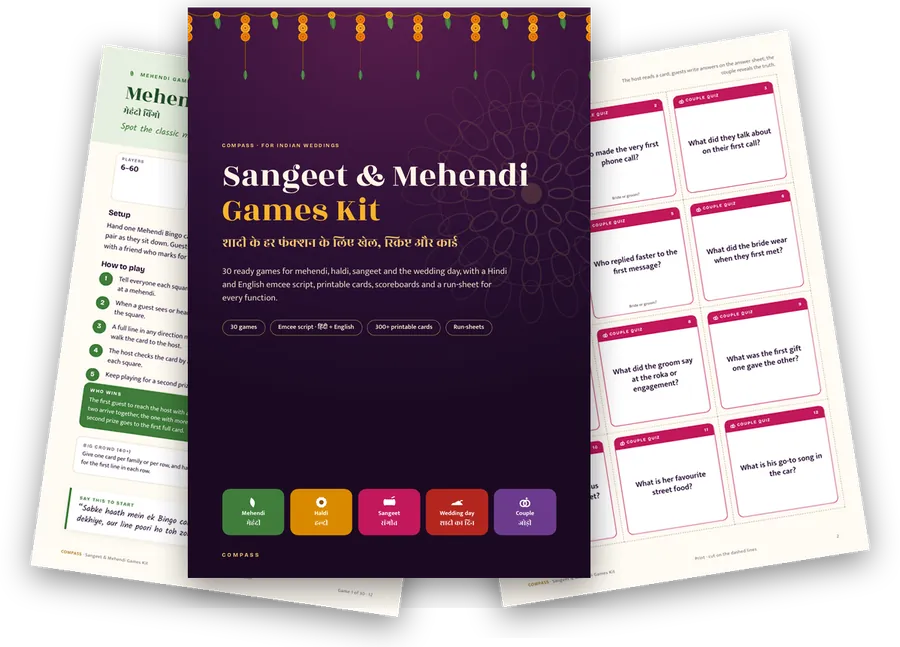
- ✓30 family-safe games with rules and timings
- ✓Emcee script in 3 languages
- ✓360+ printable cards incl. 60 shoe-game questions
- ✓Play from your phone if you have no printer
A ready 45-minute sangeet game plan
This plan suits a sangeet where games are the main event, such as a home sangeet or a smaller hall. It starts calm, builds to the stage games, and ends on the couple.
| Time | What happens | Game | Notes |
|---|---|---|---|
| 0:00 | Warm-up | Stand Up If | 6 lines, last one cues the music |
| 0:04 | Whole room joins from seats | Pass the Mic | 6 stops, at least one on an elder |
| 0:14 | Families face off | Know the Other Family | 4 questions to each side |
| 0:24 | Energy peak | Dance-Off Chits | 4 pairs, 30 seconds each, elders judge |
| 0:34 | Couple on stage | The Shoe Game | 12 questions, the last 2 sweet |
| 0:43 | Results | Scoreboard and prizes | An elder hands out prizes |
| 0:45 | Close | Dance floor opens | Cue the DJ with your last line |
What to have ready before 0:00: the scoreboard on the wall, a bowl of dance chits, your question lists in your pocket, two chairs for the couple, a prize table near the stage, and one helper to hand you things.
If your sangeet has many performances, break the same plan up: play one game in a 10-minute slot between performance blocks (Pass the Mic after the first block, Know the Other Family after the second, the Shoe Game just before the couple's dance). Never put two games back to back, or the dancers waiting backstage lose their energy.
Tip: If the room goes quiet mid-plan, switch straight to a seated game like Pass the Mic, or invite one lively cousin up first. Others follow once one person is on the floor.
Host lines to start, link and end the games
You already have a line for each game above. These link the games together:
- Opening the games block: "Ab thoda break lete hain naach se, aur khelte hain ek mazedaar game!"
- Asking for volunteers: "Iske liye mujhe chahiye do log, ek ladkewaalon ki taraf se aur ek ladkiwaalon ki taraf se. Haath upar kijiye!"
- Announcing a winner: "Toh doston, nateeje aa gaye hain! Aaj ka yeh round jeeta hai…" (wait two seconds, then say the name)
- Ending a ladkewale vs ladkiwale contest: "Aaj koi nahi haara, kyunki aaj se dono ek hi parivaar hain!"
If you are anchoring the whole evening, not only the games, our sangeet anchoring script in Hindi and Hinglish has the welcome, family intros, links between performances, shayari and closing lines.
How to keep sangeet games family-safe
A sangeet has Dadi in the front row and five-year-olds near the stage, so a few rules matter:
- No questions about money, looks, weight, jobs or past relationships. Keep it to food, habits, films and funny stories.
- Ask before you call someone up. Never pull an elder, a pregnant guest or a shy person on stage without asking first.
- Check family circumstances. If a parent has passed away or cannot attend, leave out "find your mother"-type questions and photos.
- Floor safety. Dry floors, sturdy chairs, no running in musical chairs, and wires taped down near the stage.
- No alcohol games and no adult jokes. Everything should be fine to play in front of grandparents.
For the mehendi the day before, see our list of hands-free mehendi games, made for guests who cannot use their hands.
Frequently asked questions
Which games are best for a sangeet?
For a mixed Indian crowd, the games that work best are the ones everyone can join from their seat or with one volunteer per side: Pass the Mic, Dance-Off Chits, Dumb Charades, Family Survey Says, Know the Other Family and the Shoe Game. They need almost no props and suit elders and kids.
How many games should we play at a sangeet?
Three to five games is enough for a 45-minute games block. If the sangeet is mostly performances, play 2 or 3 games in 10-minute slots between dance blocks, and never put two games back to back.
Which sangeet games work for elders?
Seated, talking and guessing games suit elders best: Pass the Mic (they can give a one-line blessing instead of dancing), Hum It, Know the Other Family, Who Said This? and Family Survey Says. Elders also make great judges for Dance-Off Chits.
How do you make the two families mingle at a sangeet?
Split the room into ladkewale and ladkiwale and keep one scoreboard for the evening. Then play games where each side answers about the other, like Know the Other Family, and end with a mixed round where the teams are made of both families.
What is the sangeet chair (kursi) game?
It is musical chairs: players walk around a circle of chairs, one fewer than the players, and sit when the music stops. In the sangeet version, the player left standing does a 10-second dance before leaving. Use sturdy chairs without wheels and a strict no-running, no-pushing rule.
Who hosts the sangeet games?
Usually a cousin, sibling or close friend who is comfortable on the mic, sometimes with a professional anchor. The host needs the rules, the props ready in one bag, a prize table near the stage and a line to start each game.
Want the cards, the script and the plan ready to print?
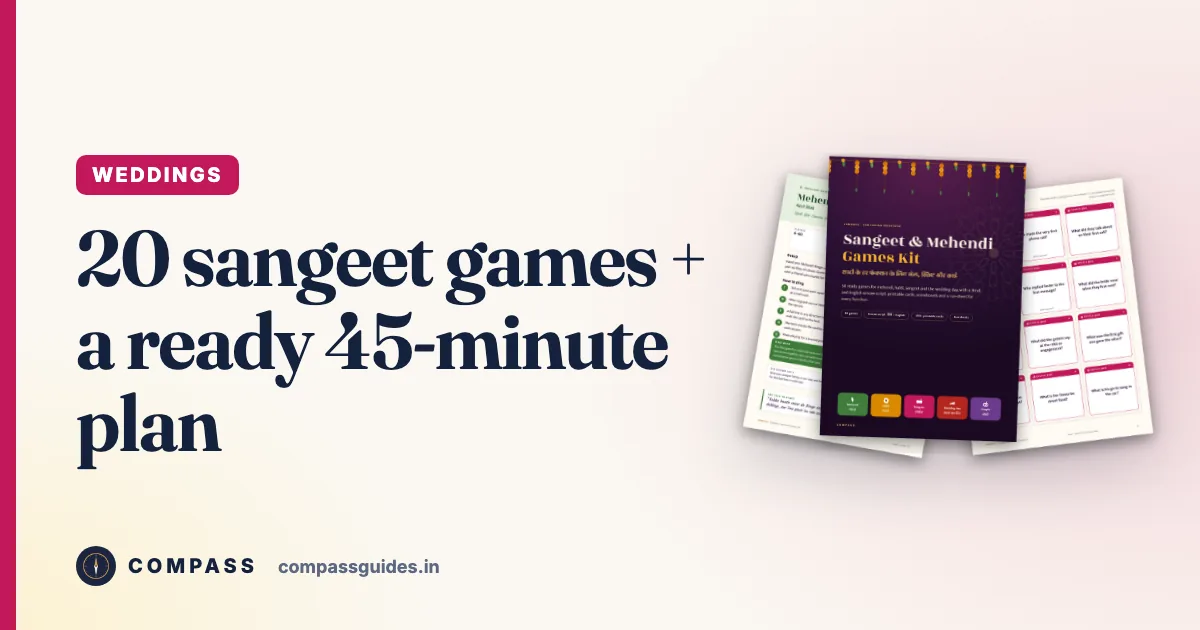
The Sangeet & Mehendi Games Kit has 30 games for mehendi, haldi, sangeet and the wedding day, an emcee script in Hindi, Hinglish and English, 360+ printable cards (shoe game, couple quiz, 120 charades films, antakshari rounds, dance-off chits) and a minute-by-minute run-sheet for every function.
See the games kit · ₹399 →