In this guide (11)
- Red flag or yellow flag: what is the difference?
- Red flags in what they say and how they behave
- Signs of control and poor boundaries
- Red flags in the family
- Money, job and the past
- Timelines and pressure
- Green flags to notice just as carefully
- How to check politely, without accusing anyone
- What to say if dowry comes up
- When should you walk away?
- FAQs
- A red flag is a pattern of dishonesty, control, disrespect or pressure. A yellow flag is something unclear that just needs a conversation.
- The serious ones: lies about job, income or a past marriage, controlling behaviour, anger at being asked questions, and any dowry demand, which is illegal under the Dowry Prohibition Act, 1961.
- Every sign here applies to any gender and any family. Watch the person and their family, and ask yourself whether your own side is showing any of them.
- Check politely: ask directly, video call, meet more than once, meet the family at home, and confirm work details through simple, public routes.
- Walk away if a serious flag is confirmed or explained away with pressure. A broken rishta is far easier to recover from than a marriage built on a lie.
Many arranged-marriage matches that do not work out end for ordinary reasons: different plans, no spark, a city neither wants to move to. That is the process doing its job. A small number of signs, though, are worth slowing down for, because they tend to grow after the wedding rather than fade.
This guide lists 21 red flags to notice early, in the person and in the family, grouped by where they show up. Each one comes with a calm way to check it. Treat each one as a prompt to ask, look again and decide with a clear head, never as an accusation on its own.
Red flag or yellow flag: what is the difference?
Not every worry is a warning. Sorting your concerns into two kinds keeps you fair to the other person and honest with yourself.
| Yellow flag | Red flag | |
|---|---|---|
| What it is | Something unclear, different or a little uncomfortable | A pattern of dishonesty, control, disrespect or pressure |
| Examples | Shy or quiet at first, very close to parents, unsure about timing of children, different hobbies, nervous on calls | Lies about job or a past marriage, dowry hints, anger at questions, checking your phone, "decide today" |
| What to do | Ask about it in the next meeting | Check it carefully, and step back if it is confirmed |
| Common mistake | Treating it as a deal-breaker too early | Explaining it away because the families are already happy |
A useful test: would this still bother me if everything else about them were perfect? If yes, it deserves a direct conversation before anyone talks about dates.
Everything below applies to both sides. A girl can be evasive about her job, a boy's mother can be controlling, a girl's father can push for an early date. Read the list for the match in front of you, and for your own family too.
Red flags in what they say and how they behave
1. Basic facts keep changing
Job title, city, salary range or education is slightly different each time it comes up. One small slip is human. A story that keeps shifting is worth noticing.
2. Simple questions get vague answers
"Where do you work?" gets "in IT, it's complicated". Some people are private, and that is fine for detailed topics. Basic facts that will be on any biodata should not be a mystery.
3. They avoid video calls or meeting in person
After several conversations, they still always have a reason not to switch on the camera or meet. It is also a common sign of a fake profile on matrimony sites.
4. They do not ask about you
The conversation is a monologue, or they never follow up on anything you share. It is normal to be nervous in the first meeting. By the third, there should be some curiosity about you.
5. They are rude to people who cannot do anything for them
Watch how they speak to waiters, drivers, delivery staff and the family's help. How someone treats people with less power is a strong hint of how they handle disagreements at home.
6. Your career, plans or opinions are brushed aside
Comments like "you won't need to work after marriage", "that course is a waste of time" or laughing off your plans. A different view is fine. Dismissing yours is the flag.
Signs of control and poor boundaries
7. They want your passwords, location or constant updates early
Asking where you are every few hours, wanting to see your chats, or wanting your social media passwords before you are even engaged. Wanting to know about your day is warm. Monitoring you is control.
8. They tell you whom to meet, what to wear or what to post
Rules about your friends, clothes or phone, presented as care ("I just worry about you"), especially before any commitment exists.
9. A reasonable question or a "no" makes them angry
You ask about loans, or say you need more time, and the reply is sulking, raised voices or guilt. How someone reacts to a calm question now is how they will react to a hard one later.
Red flags in the family
Families matter in an arranged marriage, and good families can still disagree with you. The signs below concern respect and honesty. A traditional family and a modern one can show them equally.
10. The family answers every question for them
You ask the person something and a parent replies, every time. In meeting one, some of this is normal. If it continues when you are alone, ask yourself whose decisions you would be living with.
11. Family wishes are presented as rules
"In our house, the daughter-in-law will not work." "The son-in-law must move to our city." Every family has expectations. Expectations that are not open to discussion before marriage rarely become open after it.
12. Disrespect towards your parents
Talking down to your family, making them wait, mocking their customs or their means. Two families will be connected for life, so this one matters to both sides.
13. Any talk of dowry, "lena-dena" or what they "deserve"
A list of items, a car, cash, gold, or a vague "you know what is expected in our community". Giving, taking or demanding dowry is an offence under the Dowry Prohibition Act, 1961. It is a red flag however politely it is phrased, and whichever side raises it.
14. Sudden new conditions after the families have agreed
The venue, the wedding budget, gifts or the couple's living arrangements change at the last minute, with pressure to accept because "everything is already fixed".
Money, job and the past
15. The job or income does not check out
The company has never heard of the role, the salary is far from what the lifestyle suggests, or "I work from home for a foreign company" is all you ever hear. Lies about job or income are serious, because they are lies about the life you would be building together.
16. Hidden loans or money trouble
You learn about large EMIs, a failing business or debts from someone else, not from them. Plenty of good partners have loans. Keeping them hidden is what damages trust.
17. A past marriage or engagement is concealed
A previous marriage, divorce or broken engagement is nobody's shame, and many people remarry happily. Hiding it is different. Lies about a past marriage are serious, both for trust and because a person's marital status has legal consequences.
18. Important facts are saved for "after marriage"
"We'll tell you everything after the wedding" about health, money, a past relationship or living plans. Anything that would change your decision belongs before the decision.
Timelines and pressure
19. A rush to fix the date
"The pandit has given a muhurat in three weeks." Sometimes there is a real reason, such as an elder's health or a family event, so ask what it is. It becomes a red flag when the hurry means you cannot meet enough times to answer the big questions.
20. Pressure to decide today
"We need an answer by tonight." "Other families are waiting." A good match is still a good match next week.
21. They resist you meeting alone or meeting their family
They avoid one-on-one time, or keep you away from their home, parents or friends. In a marriage, you will meet all of them. Seeing them before is reasonable.
- ✓101 questions across 11 themes
- ✓What to notice in the first few meetings
- ✓Scripts for talking to your parents
- ✓Red and green flags + a decision scorecard
Green flags to notice just as carefully
Worry is loud and good signs are quiet, so make a point of noticing these too:
- They answer money and family questions calmly, even when the answer is not ideal.
- They ask about your plans and remember what you said last time.
- They talk about their parents warmly and still have their own opinions.
- They are kind to staff and strangers.
- They share something difficult about themselves without being asked.
- They respect your "I need more time" without sulking.
- Their story stays the same across meetings, families and friends.
How to check politely, without accusing anyone
Most of this is simply good homework, and it works best done openly.
- Ask directly, once, calmly. "I heard there may be a business loan. Is that right? I'm only asking so we start honestly." Honest people usually appreciate the chance to explain.
- Meet more than once. Three to five conversations, including calls, show patterns that one meeting hides.
- Insist gently on a video call before meeting someone from a matrimony site, and meet in a busy public place the first time.
- Visit their home and meet the family where they live, not only at a café or your home.
- Confirm work through simple routes. A professional profile, meeting near their office, or a mutual contact in the same field. Most people with a real job do not mind.
- Ask people who know them. Relatives, family friends, colleagues. Listen for consistent stories rather than single opinions.
- Write it down. Notes after each meeting stop you from forgetting the one thing that worried you once everyone is excited.
Tip: Never send money to someone you have not met, for any reason: customs fees, a medical emergency, a "gift" that is stuck. These are common matrimony-site scams. You can report online fraud on the national cyber crime helpline, 1930, or at cybercrime.gov.in.
Our list of questions to ask before an arranged marriage has gentle wording for salary, loans, past relationships and living arrangements, so checking does not have to feel like an interrogation.
What to say if dowry comes up
Keep it short, calm and clear. You do not need to argue.
- "We don't give or take dowry. If that's important to your family, it's better we both know now."
- "My parents and I would like a simple wedding with costs shared fairly. Gifts beyond that aren't part of our plan."
If the demand continues, step back from the match. Talk to your parents, and if needed to a lawyer. If anyone ever threatens you or you feel unsafe, call 112, the national emergency number.
When should you walk away?
Some concerns need a conversation. These usually need a decision:
- A lie about job, income, education or a past marriage is confirmed.
- There is a dowry demand, in any form.
- They show controlling behaviour and do not change when you name it.
- Anger, threats or guilt follow when you ask questions or ask for time.
- You are being pushed to decide before you have had enough meetings to know them.
- You feel you are saying yes mainly because others want you to.
Walking away is hard when families are happy and relatives have heard the news. Say it simply to your parents: "Something important didn't add up, and I'm not comfortable going ahead. I'd rather stop now than regret it later." Many parents, once they hear the reason, want the same thing you do.
A rishta that ends early is a small loss. Use the flags here as reasons to ask good questions, not to suspect everyone, and you will be fair to the people you meet and kind to yourself.
Frequently asked questions
What are the biggest red flags in an arranged marriage?
The most serious are lies about job, income, education or a past marriage; controlling behaviour such as demanding your passwords or telling you whom to meet; anger when you ask reasonable questions; dowry demands of any kind; and pressure to decide or fix a date before you have had time to talk.
Is asking for dowry illegal in India?
Yes. Under the Dowry Prohibition Act, 1961, giving, taking or demanding dowry is an offence, and that includes demands framed as gifts, "lena-dena" or what the family "deserves". If you face a demand, step back from the match. You can file a complaint with the police or the Dowry Prohibition Officer in your district, and talk to a lawyer; in an emergency, call 112.
How do I check if a boy's or girl's job is real?
Ask about their work in detail across meetings and see whether the story stays consistent. Look at their professional profile, ask to meet near their office, or ask a mutual contact who works in the same field. Someone with nothing to hide usually does not mind.
Is it a red flag if he or she is very close to their parents?
Not by itself. Being close to family is common and often a good sign. It becomes a yellow flag only if they cannot answer any question or make any decision without a parent, and a red flag if their family's wishes are presented as rules you must accept.
Is rushing the wedding date a red flag?
Sometimes it is just an auspicious date or a family situation, so ask why. It becomes a red flag when the hurry stops you from meeting enough times, or when questions are met with "you can ask all this after marriage".
What should I do if I notice a red flag after the engagement?
Talk to the person directly and calmly, then to your parents or someone you trust. An engagement is not a marriage. If a serious concern is confirmed, stepping back now, even if it is uncomfortable, is the safer choice for everyone.
Decide with a clear head, and the right words ready
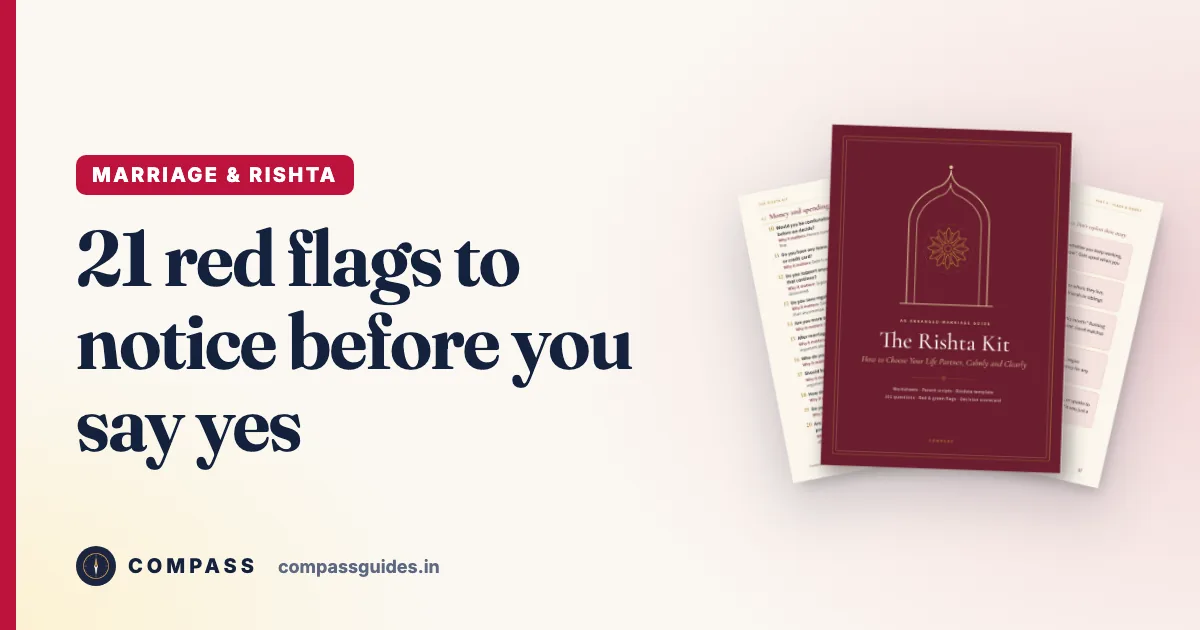
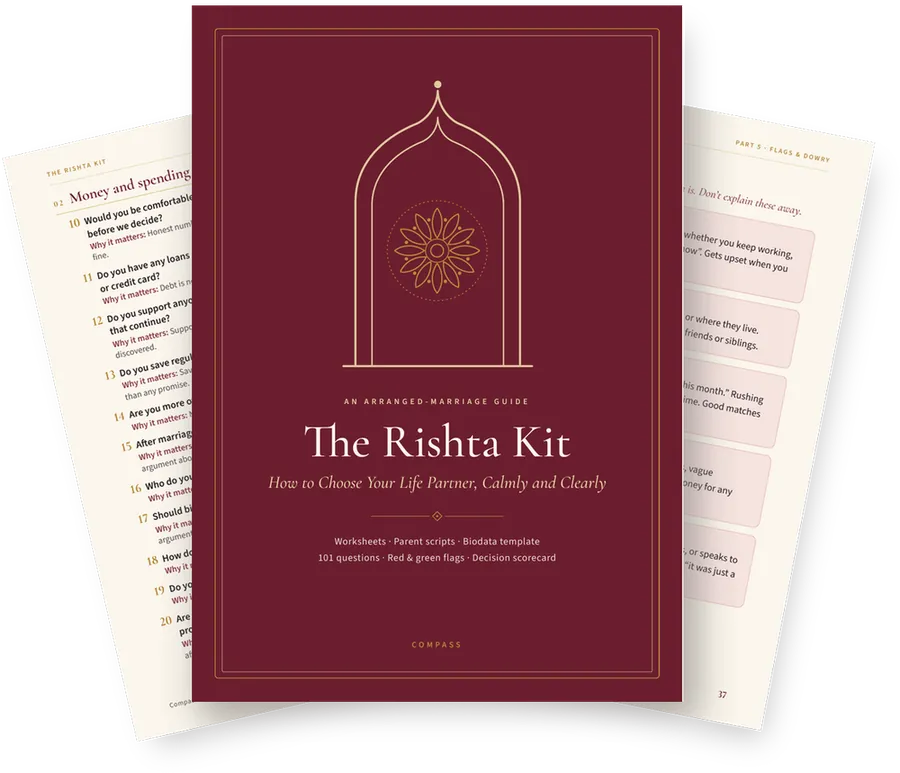
The Rishta Kit has a full green flags and red flags section, calm words if dowry comes up, matrimony-site safety, kind ways to say no at every stage, 101 questions with why each one matters, and a decision scorecard.
See the Rishta Kit · ₹199 →