In this guide (10)
- What should you know before the first meeting?
- First meeting questions: light, easy and still revealing
- Second and third meeting: the questions that decide a marriage
- Questions girls often want to ask a boy
- Questions boys often want to ask a girl
- Questions to ask the other family
- How to ask these without it feeling like an interview
- Which questions should you avoid in the first meeting?
- How many meetings before you say yes?
- FAQs
- Keep the first meeting light: work, routine, family, what they enjoy. Save salary, loans, kids and living arrangements for meetings 2 and 3.
- The questions that matter most later: career after marriage, money and EMIs, where you will live, children, and who does the housework.
- Ask the same big questions both ways. Every question here works for a girl or a boy; the split below just reflects what each side often worries about.
- Make it a conversation: share your own answer first, ask one deep question at a time, and never read off your phone.
- Plan for 3 to 5 conversations (calls count) before you can answer the big questions. Asking for more time is normal.
You do not need a hundred questions in the first meeting. You need the right few in each meeting, asked in a way that feels like a conversation, so that by the time families start talking about dates you actually know the person.
This guide gives you 75 questions to ask before an arranged marriage, grouped by when to ask them: the light ones for meeting one, the deeper ones for meetings two and three, then separate lists for what girls and boys often want to know, and a few for the family. After that, how to ask the awkward ones without it turning into an interview.
What should you know before the first meeting?
Some things are already in the biodata or have come through the families. Read them again so you do not waste the meeting on them, and so you can spot anything that does not match later.
- Basics: education, job title, company, city, family members and what they do.
- Two things you are curious about: a hobby, a city they lived in, a line in their profile. These make easy openers.
- Your own non-negotiables: three or four things you truly cannot compromise on (for example, continuing your career, living in a particular city, wanting children). Write them down, read them once, then put the list away.
- What your parents already discussed: ask them directly. It is awkward to learn in the meeting that the families have already talked about the wedding date.
Tip: Treat the first meeting as answering one small question: "Would I like to talk to this person again?" That takes the pressure off both of you.
First meeting questions: light, easy and still revealing
The first meeting is for comfort and a sense of the person. These questions are easy to answer, but the answers tell you a lot about how someone thinks, what energises them and how they talk about others.
- What do you enjoy most about your work, and what would you change about it?
- What does a normal weekday look like for you, from morning to night?
- How do you usually spend your weekends?
- Tell me about your family. Who are you closest to?
- What made you decide to start looking for a partner now?
- Which city or place feels most like home to you, and why?
- What do you do when you want to relax after a hard week?
- Who are your closest friends, and how did you meet them?
- What is something you have learnt or got into recently?
- What is a place you have travelled to that you would go back to?
- What is something people usually get wrong about you when they first meet you?
- What are you looking forward to in the next year?
Share your own answer after each one. If you ask twelve questions and answer none, it feels like a form.
Second and third meeting: the questions that decide a marriage
Once there is some comfort, usually by the second or third meeting (calls count), move to the topics that shape daily married life. Do not cover all of them in one sitting. Two or three themes per conversation is plenty.
Career and ambitions
- Where do you see your career in five years?
- Are you planning a big change soon, such as a new job, higher studies, a business or a move abroad?
- How many hours do you usually work, and how often do you travel for work?
- How do you feel about my career? Do you see it as equal in importance to yours?
- Would you be comfortable if I earned more than you, or less than you?
- If one of us got a great opportunity in another city, how would we decide?
- What would you do if you lost your job tomorrow?
Money and spending
- Would you be comfortable sharing your approximate salary before we decide? A range is fine.
- Do you have any loans or EMIs right now: education, car, home, personal or credit card?
- Do you support anyone financially, such as parents or siblings, and will that continue after marriage?
- Do you save regularly? Roughly what share of your income?
- Are you more of a spender or a saver? What do you love spending on?
- After marriage, do you imagine joint accounts, separate accounts or a mix?
- Should big purchases be decided together? What counts as "big" for you?
- What do you think about the wedding budget, and who should pay for what?
Supporting parents, having an education loan or preferring separate accounts are all normal. What causes trouble later is finding out after the wedding. Agreeing on a number for "big purchase" (say ₹20,000) heads off a lot of small arguments.
Family and living arrangements
- After marriage, do you see us living with your family, near them, or on our own?
- If we live with family, what would a normal day look like for each of us?
- How are decisions made in your family, and who usually has the final word?
- How involved do you expect your parents to be in our decisions, like money, jobs or children?
- How often would you want to visit or spend festivals with each of our families?
- If your parents and I disagreed about something, what would you do?
- Do you see yourself looking after your parents as they get older? How?
- How far from your parents would you be comfortable living?
- How would you feel about me staying close to my own parents, and supporting them if needed?
The label (joint family or nuclear) matters less than the daily routine. Ask who cooks, who wakes up when, whether you can go out with friends on a Saturday, and how much privacy the couple gets. Those answers are what you will actually live with.
Children
- Do you want children? Is that a firm yes, a firm no, or open?
- If yes, roughly when, and how many do you imagine?
- How would we share childcare, and would either of us change our work for it?
- If we had trouble having children, how would you feel about options such as treatment or adoption?
- What from your own upbringing would you repeat, and what would you do differently?
The first question is one of the few true deal-breakers. Never assume the answer, and never let it be "we'll see after marriage" if it matters to you.
Values, lifestyle and habits
- How important is religion or spirituality in your daily life? What does that look like in practice?
- Are there food habits that matter to you, such as vegetarian, non-veg at home, or fasting days?
- Do you drink or smoke? How often? Would you expect me to?
- Are you a morning person or a night person? How do you like your weekends?
- How do you look after your health, physically and mentally?
- What does a "good life" look like to you in ten years?
- How do you treat people who cannot do anything for you, like staff, drivers or delivery people?
- What is one thing you would never compromise on in a marriage?
"Occasionally" can mean once a year or every weekend. If drinking, smoking or food habits matter to you, ask what the word means to them.
Conflict and household work
- When you are upset, do you prefer to talk right away or take some time first?
- How did your parents handle disagreements, and what did you learn from that?
- Is it ever okay to shout, go silent for days or walk out during a fight?
- Would you be open to counselling if we struggled one day?
- How do you imagine sharing cooking, cleaning, laundry and groceries?
- What household work do you already do yourself today?
The last one is the honest check on the one before it. Housework is daily, and a vague "we'll manage" turns into one person managing everything.
- ✓101 questions across 11 themes
- ✓What to notice in the first few meetings
- ✓Scripts for talking to your parents
- ✓Red and green flags + a decision scorecard
Questions girls often want to ask a boy
Every question in this guide works in both directions. The two lists below simply reflect what each side often worries about. Use whatever fits you.
- Do you expect me to continue working after marriage? How would you feel if I wanted to change cities or take a break, or never take one?
- What will my day look like at your home: cooking, guests, puja, timings? What is expected, and by whom?
- Will I be free to meet my friends, visit my parents and travel without needing permission?
- How would you handle it if your mother and I saw something differently?
- Can you cook, and do you do your own laundry and cleaning today?
- What are your family's expectations around the wedding, gifts or "lena-dena"? Is anything expected from my side?
- Have you been engaged or married before, or in a serious relationship that I should know about?
- If I wanted to keep my own bank account and decide how to use my salary, would that be okay with you?
If the question about lena-dena gets an answer that includes a list of items or an amount, read our guide to arranged marriage red flags. Dowry demands are illegal in India under the Dowry Prohibition Act, 1961.
Questions boys often want to ask a girl
- What are your career plans for the next five years, and how should our plans fit together?
- How do you feel about living with my parents, near them or separately? What would make it work for you?
- My parents depend on me partly. How do you feel about that continuing after marriage?
- What do you expect from a husband day to day, beyond the big things?
- How close are you to your family, and how often would you like to see them?
- Have you been engaged or married before, or in a serious relationship that I should know about?
- Are you happy with this match yourself, or do you feel pressure from home to say yes?
The last question deserves a real answer from both people. A yes that comes from pressure is a weak start for anyone, and it is kinder to ask now than to find out later.
Questions to ask the other family
When the families meet, parents usually lead. These questions keep it respectful while still getting real answers.
- What are you hoping for in your son's or daughter's partner?
- How does your family usually celebrate festivals, and what traditions matter most to you?
- How do you see the couple's life after marriage: where they live, and how much you would like to be involved?
- What kind of wedding do you have in mind, and how do you think costs should be shared?
- Is there anything about your family we should know, so there are no surprises later?
That makes 75. If you get honest, calm answers to most of them across a few meetings, you will know this person far better than one or two formal meetings ever allow.
How to ask these without it feeling like an interview
The questions above are blunt on paper. In real life, a few habits make them feel natural.
- Go first. Share your own answer, then ask theirs. "I have an education loan with two years left. Do you have any EMIs?" feels very different from "Do you have loans?"
- One deep question per stretch. Ask, listen, follow up, and then let the talk drift somewhere light before the next one.
- Explain why you are asking. "I'm asking because my parents and I want to plan honestly" removes any sense of judgement.
- Never read from your phone. Pick 3 or 4 questions before the meeting and remember them. Your list is for you, not the table.
- Use "imagine" and "usually". "How do you imagine weekends after marriage?" invites a picture. "Will you let me go out?" invites a defence.
- Notice the way they answer. Calm, open and a little thoughtful is a good sign, even if the answer differs from yours. Irritation at being asked at all is worth noting.
Gentle wording for the awkward questions
| Instead of | Try |
|---|---|
| "What is your salary?" | "Would you be comfortable sharing a rough range? I'll share mine too. It helps us plan honestly." |
| "Will I have to live with your parents?" | "After marriage, how do you picture our living set-up? What would a normal day look like?" |
| "Will you let me work?" | "How do you see both our careers fitting together over the next few years?" |
| "Any past relationships?" | "Is there anything from your past you'd want me to know before we decide? I'm happy to share mine." |
| "How many kids?" | "Do you see children in our future? Roughly when?" |
| "What will your family expect from us?" | "What does your family usually expect around weddings and festivals, so my parents and I understand?" |
| "Do you drink?" | "What's your relationship with drinking or smoking? I'll tell you mine." |
Tip: If something truly matters and the moment never feels right, say so plainly: "There are a couple of practical things I'd like to talk about before we decide. Is it okay if we do that next time?" Most people respect it.
Which questions should you avoid in the first meeting?
These topics are not off-limits forever. They simply land better once there is some trust, and a few should never be asked at all.
| Leave it for later or skip it | Why |
|---|---|
| Exact salary, assets, property | Important, but asking first feels transactional. Ask by meeting 2 or 3. |
| Detailed past relationships | Needs trust. A gentle "anything I should know" works later. |
| "How many children do you want?" | Ask whether they want children by meeting 2. Details can wait. |
| Health conditions | Private, and deserves a calm, trusted setting. |
| "Why aren't you married yet?" | Sounds like an accusation even when meant kindly. |
| "Will you leave your job after marriage?" | Ask about career plans openly instead. |
| Weight, looks, skin colour | Never appropriate, in any meeting. |
| Caste or "family status" comparisons | Feels like an audit and pushes away good people. |
| The wedding, dowry or gifts | None of it belongs in a first meeting. |
For everything else about meeting one, from what to wear to whether to carry sweets, see our first meeting guide.
How many meetings before you say yes?
There is no correct number. A practical test: you are ready to decide when you have heard honest answers on career, money, family and living arrangements, children, and how they handle disagreement. Covering all of that usually needs 3 to 5 conversations, often a mix of calls and meetings.
If the families want a decision before you have covered these, you can ask for time without upsetting anyone:
- To your parents: "I like them, and I want to be sure. Can we have one more meeting before we talk about dates?"
- To the other person: "I've really enjoyed talking. There are a couple of things I'd like to understand better. Could we meet once more?"
Your parents have your interest at heart, and their view of the family is valuable. The decision about the person, though, is yours to make, and good questions are how you make it with a clear head.
Frequently asked questions
What should I ask in the first arranged marriage meeting?
Keep it easy: what they enjoy about their work, what a normal weekday looks like, how they spend weekends, what their family is like and what made them start looking now. The goal of meeting one is only to decide whether you want to talk again.
What should not be asked in the first meeting?
Leave exact salary, property, past relationships, health conditions and detailed questions about children for later meetings. Never ask about weight, looks, skin colour or caste comparisons, and avoid "Why aren't you married yet?", which sounds like an accusation.
How do you ask about salary politely?
Share first and ask for a range: "I earn around X, and I have an education loan with two years left. Would you be comfortable sharing a rough range? I think it helps us plan honestly." Ask this by the second or third meeting, not the first.
How do you talk about living with in-laws?
Ask what they imagine, without putting your preference first: "After marriage, do you see us living with your family, near them, or on our own?" Then ask what a normal day would look like in that set-up, because the daily routine matters more than the label.
How many meetings before saying yes to an arranged marriage?
There is no fixed number, but plan for 3 to 5 conversations, including calls, to cover career, money, family, living arrangements and children. If you are being asked to decide before these topics have come up, it is fine to ask for one more meeting.
Can a girl ask the boy about his salary and loans?
Yes. Money questions are fair for both sides, and a good partner will answer them calmly. Ask by meeting 2 or 3, share your own numbers too, and a range is enough before you decide.
Want all 101 questions, and the words for the hard parts?
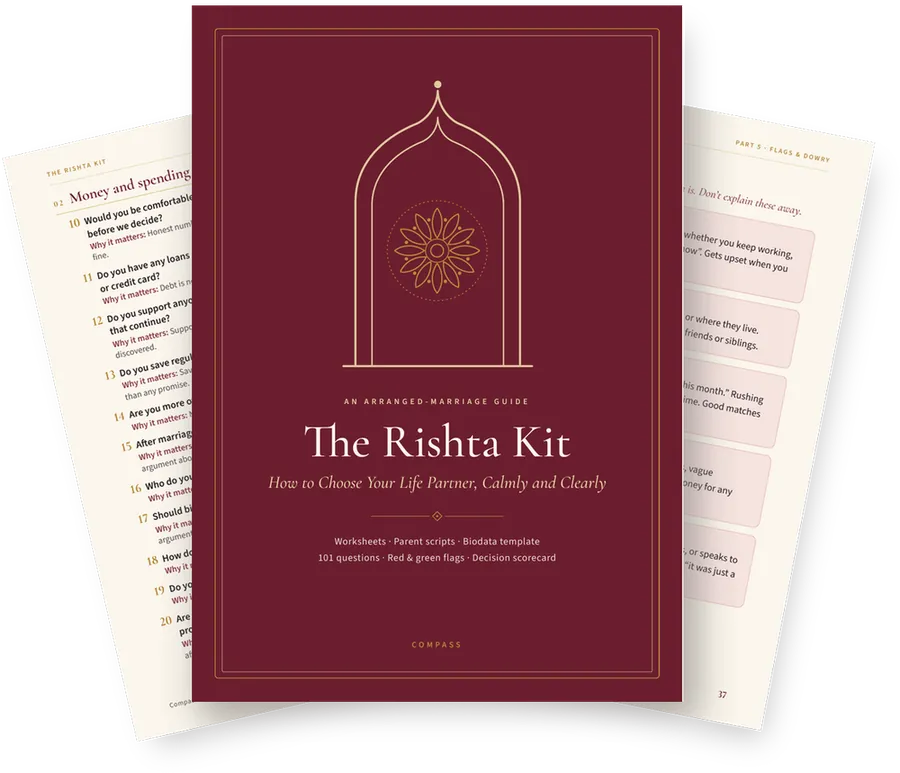
The Rishta Kit is a 59-page PDF with 101 questions across 11 themes, each with why it matters, plus a first call and first meeting plan, scripts for talking to your parents, green and red flags, a families' meeting checklist and a decision scorecard.
See the Rishta Kit · ₹199 →